
Conversion in progress ...
Please wait while we generate your PDF
Seller Mistakes to Avoid
QUICK SUMMARY
What you'll learn in 5 minutes:
- The pricing mistake that costs sellers 5-10% of their home's value (and how to avoid it)
- Why professional photography isn't optional—and what happens when you skip it
- The showing and access mistakes that eliminate 70%+ of potential buyers
- How to evaluate offers beyond just the price (and avoid accepting the wrong one)
- The preparation shortcuts that backfire every single time
- Why "testing the market" is the most expensive experiment you can run
- A self-assessment checklist to ensure you're avoiding all seven mistakes

You Can't Afford to Learn These Lessons the Hard Way
Selling a home is one of the biggest financial transactions most people ever make. Get it right and you walk away with maximum proceeds, minimal stress, and a smooth closing. Get it wrong and you leave tens of thousands of dollars on the table while enduring months of frustration.
Here's what we've learned after helping hundreds of families sell homes in Cypress and Orange County: The difference between a successful sale and a disappointing one usually comes down to seven specific, avoidable mistakes.
Most sellers don't even realize they're making these mistakes until it's too late. The home sits. Buyers skip it. Price reductions follow. And by the time they course-correct, they've already lost the momentum and money they can't get back.
This guide walks you through each mistake, explains why it's so costly, and shows you exactly how to avoid it.
This is for you if:
- You're preparing to list and want to do it right the first time
- You've seen homes sit on the market and want to understand why
- You're determined to maximize your sale price and minimize time on market
- You want to learn from other sellers' mistakes instead of making them yourself
- You're ready to approach this like a strategic business decision, not a hopeful experiment
START HERE (30 SECONDS)
Find your situation below and jump to the section that matters most:
- I'm tempted to price high and see what happens" → Jump to "Mistake #1: Overpricing from Day One"
- "I'm thinking about using iPhone photos to save money" → Go to "Mistake #2: Skipping Professional Photography"
- "I want to control when buyers can see my house" → Read "Mistake #3: Making Showings Difficult"
- "I'm planning to choose the highest offer automatically" → Start with "Mistake #4: Accepting the Wrong Offer"
- "I'm exploring all seven mistakes" → Read straight through
What Most Sellers Get Wrong About Selling
A seller checks an online estimate. They get excited (or disappointed). They start planning based on that number. They either overprice their home because "Zillow says it's worth this" or underprice it because they don't understand what drives value in their specific neighborhood.
Then reality hits:
Scenario 1: They list at the Zestimate. The home sits. No offers. They reduce the price three times over four months and eventually sell for less than if they'd priced it correctly from day one.
Scenario 2: They assume their online estimate is too high and price below market. The home sells in 48 hours with multiple offers, and they realize afterward they left $30,000-$50,000 on the table.
Both scenarios are expensive mistakes rooted in the same problem: relying on algorithms instead of analysis.
The myth: "Online estimates are pretty accurate these days."
The reality: They're a starting point, not a finish line. And they're often significantly wrong—especially for unique properties, upgraded homes, or in neighborhoods with limited recent sales data.
Mistake #1: Overpricing from Day One
This is the single most expensive mistake sellers make. And it's the most common.
Why Sellers Overprice
The reasoning sounds logical:
- "Buyers will negotiate down anyway, so I'll start high"
- "I can always reduce the price if I need to"
- "My home is nicer than the comps, so I deserve more"
- "I need to net a certain amount to make my plans work"
- "Let's test the market and see what happens"
Here's why every one of those reasons backfires:
The First Two Weeks Are Everything
Your home gets maximum visibility in the first 14 days on market. This is when:
- Your listing appears as "new" on all platforms
- Buyers who've been searching get automatic notifications
- Agents show it to clients actively looking
- Curiosity and competition are highest
If you're overpriced during this window, you waste your best opportunity.
Buyers tour your home, compare it to properly-priced competition, and choose the better value. You don't get a second chance to make a first impression on those buyers—they've already eliminated you.
The Stigma of Price Reductions
What happens when you reduce your price:
Price reduction #1: "Hmm, why didn't it sell?"
Price reduction #2: "Something must be wrong with it."
Price reduction #3: "This seller is desperate. Let's lowball them."
The data shows: Homes that undergo multiple price reductions sell for 5-10% less than if they'd been priced correctly from day one—even after accounting for the reductions.
You don't just lose the time. You lose negotiating leverage and buyer confidence.
The "Testing the Market" Trap
Sellers think: "If I price high and it doesn't sell, I'll just lower it."
The reality: You've now trained the market that your home is overpriced. Buyers who saw it initially won't come back (they've already bought something else or dismissed your home). New buyers see a stale listing with price reductions and wonder what's wrong.
Testing the market doesn't give you information. It costs you money.
How to Price It Right
The correct approach:
- Analyze recent comparable sales (not active listings, not your hopes)
- Adjust for your home's specific condition and features
- Consider current market momentum
- Price at or slightly below market value to generate competition
- Let buyer demand push the price up through multiple offers
Example of strategic pricing:
Your home's true value: $700,000-$720,000
- Wrong approach: List at $749,000 "to leave room for negotiation"
- Result: Minimal showings, sits for weeks, reduces to $725,000, then $699,000, finally sells for $685,000
- Right approach: List at $699,000 to create urgency
- Result: Multiple showings in first week, 3-5 offers, sells for $715,000-$730,000 due to competition
You net $30,000-$45,000 more by pricing strategically from day one.
Mistake #2: Skipping Professional Photography (Or Using Bad Photos)
If pricing is the most expensive mistake, photography is the most common visibility killer.
Why Photography Matters More Than Ever
The reality of modern home shopping:
- 95%+ of buyers start their search online
- Buyers spend an average of 15-30 seconds scanning your listing photos
- If your photos don't grab them, they never schedule a showing
- You can't sell a home that buyers never come to see
Your photos aren't just documentation. They're your first—and often only—impression.
What Bad Photography Costs You
Bad photos lead to:
- 70% fewer online views compared to professional photography
- 50% fewer showings scheduled
- Longer time on market (which compounds other problems)
- Lower final sale price due to reduced competition
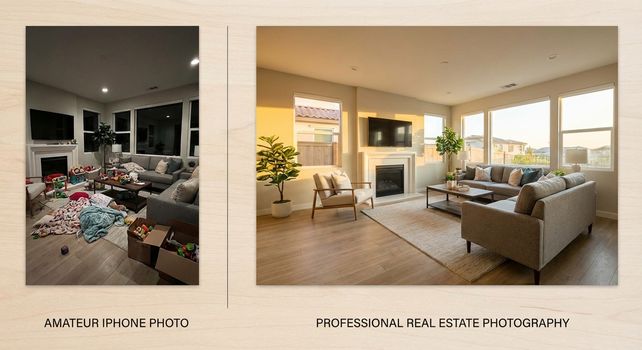
You can have the nicest home on the block, but if your photos are dark, cluttered, poorly angled, or shot on an iPhone, buyers will never know.
The Amateur Photography Mistakes
We see these constantly:
- Dark, poorly-lit rooms (buyers assume the home is small and depressing)
- Cluttered, lived-in spaces (buyers can't envision themselves there)
- Bad angles (rooms look smaller than they are)
- Poor color balance (everything looks dingy or unnatural)
- Missing key selling features (backyard, upgrades, unique details not captured)
- Vertical iPhone photos (unprofessional, screams "amateur listing")
Even worse: Reusing old photos from when you bought the home. They're outdated, don't reflect your current condition, and signal a lazy listing.
What Professional Photography Provides
A professional real estate photographer delivers:
- Proper lighting that makes spaces feel bright and inviting
- Wide-angle lenses that showcase room size accurately
- HDR processing that balances interior and exterior light
- Staging-aware angles that highlight key features
- Twilight exterior shots that create emotional appeal
- Drone photography for properties with land or views
Cost: $300-$500 typically
Return: Homes with professional photography sell 32% faster and for 3-5% more on average
On a $700,000 home, that's $21,000-$35,000 in additional proceeds for a $400 investment.
The Photo Quality Self-Test
Look at your planned photos and ask:
- Would I click on this listing if I were searching online?
- Do these photos make the home look as good as it actually is in person?
- Are the rooms bright, spacious, and inviting?
- Can buyers clearly see the home's best features?
- Do these photos differentiate my home from the competition?
If you answered "no" to any of these, you need professional photography.
Mistake #3: Making Showings Difficult
This mistake eliminates qualified buyers before they ever see your home.
The Showing Access Mindset Shift
How sellers think about showings:
"This is my home. Buyers can accommodate my schedule."
How buyers think about showings:
"I have limited time. I'll see the homes that make it easy and skip the ones that don't."
Reality check: Buyers are shopping multiple homes. If yours requires advance notice, limited hours, or complicated access, they'll simply choose from the other 10 homes on their list that are easier to see.
The Most Common Showing Mistakes
Mistake: "I need 24 hours notice"
Why it fails: Buyers often make last-minute decisions. An agent calls at 2 PM asking to show at 4 PM. You say no. Buyer sees five other homes instead and writes an offer on one of them. You never get a second chance.
Mistake: "Showings only on weekends or after 5 PM"
Why it fails: You've eliminated everyone who works evenings or has weekend commitments. You've also eliminated agents who show homes during business hours (which is most of them).
Mistake: "We need to be home during showings"
Why it fails: Buyers feel uncomfortable evaluating your home honestly with you present. They rush through. They don't open closets or envision it as theirs. They leave quickly and forget about it.
Mistake: "Let me tidy up first—give me an hour"
Why it fails: By the time you're ready, the buyer has moved on to the next showing. Timing is everything.
The Showing Access Best Practices
Maximize showings by:
- Using a lockbox so agents can access the property without you
- Allowing same-day showings whenever possible (2-3 hours notice is ideal)
- Being gone during showings so buyers can explore comfortably
- Keeping the home "show-ready" at all times so you're never scrambling
- Saying yes to awkward times (early morning, late evening) when you can
The mindset shift: Every showing you decline is a potential buyer you've eliminated.
The exception: Legitimate safety or security concerns. But even then, use lockboxes and coordinate through agents rather than restricting access.
What Flexible Showing Access Gets You
Homes with easy showing access:
- Receive 3-5x more showings
- Sell 2-3 weeks faster on average
- Generate more competing offers
- Command higher prices due to increased competition
Think of it this way: Every showing is a lottery ticket. The more tickets you have, the better your odds of finding the right buyer at the right price.
Mistake #4: Accepting the Wrong Offer
You've generated multiple offers. Congratulations. Now comes the mistake that costs sellers thousands: choosing based on price alone.
Why the Highest Offer Isn't Always the Best Offer
A strong offer includes:
- Competitive price (but not necessarily the highest)
- Solid financing (pre-approval from reputable lender, strong down payment)
- Minimal contingencies (or realistic ones with clear timelines)
- Flexible closing timeline (matches your needs)
- Earnest money deposit (shows commitment)
- Proof of funds (for down payment and closing costs)
A weak offer with a high price:
- Looks great on paper
- Falls apart during inspection, appraisal, or financing
- Costs you 2-4 weeks while the deal dies
- Forces you back on market as a "failed sale" (stigma)
- Results in lower final price when you relist
The Red Flags in Offers
Watch out for:
Red Flag #1: Weak or no pre-approval
- "Pre-qualified" vs. "pre-approved" (big difference)
- Pre-approval from unknown online lender
- FHA/VA financing on a property that may not qualify
- Buyer stretching to maximum loan amount with minimal down payment
Red Flag #2: Excessive contingencies
- "Sale of buyer's home" contingency with no backup plan
- Long inspection timelines (14-21 days suggests they're unsure)
- Vague contingency language that gives buyer unlimited outs
- Financing contingency with no deadline
Red Flag #3: Low earnest money deposit
- Deposit under 1-2% of purchase price suggests weak commitment
- Buyer unwilling to increase deposit shows lack of seriousness
Red Flag #4: Unrealistic timelines
- Buyer needs 60+ days to close (why? financing issues? selling another property?)
- Buyer wants to close in 10 days (can they actually perform that fast?)
Red Flag #5: Too many special requests
- Wants you to leave all appliances, furniture, window treatments
- Requests excessive seller credits or repairs before seeing inspection
- Wants rent-back terms that benefit them and risk you
How to Evaluate Multiple Offers
Create a scorecard for each offer:
| Factor | Weight | Offer A | Offer B | Offer C |
|---|---|---|---|---|
| Price | 40% | $720K | $735K | $715K |
| Financing strength | 25% | Strong | Weak | Strong |
| Down payment % | 15% | 20% | 10% | 25% |
| Contingencies | 10% | Standard | Excessive | Minimal |
| Closing timeline | 5% | Flexible | Fixed | Flexible |
| Earnest deposit | 5% | $15K | $7K | $18K |
In this example:
- Offer B has the highest price but weakest financing and lowest deposit
- Offer C is slightly lower price but strongest overall package
- Offer A is middle ground
Best choice: Likely Offer C (lower price but highest probability of closing)
Risky choice: Offer B (highest price but highest failure risk)
The Counter-Offer Strategy
Don't just accept or reject. Use counter-offers strategically:
If you have multiple strong offers:
- Counter all of them with your best terms
- Create competition by letting them know there are multiple offers
- Push price up while maintaining strong terms
If you have one strong offer and one weak offer:
- Counter the strong offer with minor improvements
- Use the weak offer as leverage but don't rely on it
If all offers are weak:
- Counter the best one with strengthened terms (bigger deposit, shorter contingencies, better financing)
- Be prepared to wait for better buyers if terms don't improve
Mistake #5: Poor Home Preparation
This mistake shows up in reduced offers, longer market time, and buyer concerns during inspection.
The Preparation Spectrum
Level 1: Basic (Minimum acceptable)
- Deep clean
- Declutter
- Minor repairs (burnt-out bulbs, leaky faucets, loose handles)
- Lawn mowed, exterior tidy
Level 2: Strategic (Recommended)
- Everything in Level 1, plus:
- Fresh interior paint in neutral colors
- Clean or replace worn carpet
- Update dated fixtures (faucets, lighting, cabinet hardware)
- Professional staging or staging consultation
- Curb appeal boost (mulch, potted plants, power washing)
Level 3: Comprehensive (High-end properties)
- Everything in Level 2, plus:
- Kitchen/bathroom updates if very dated
- Flooring replacement if necessary
- Landscaping refresh
- Professional staging with rental furniture
The mistake: Most sellers do Level 0 (nothing) or bare-minimum Level 1, then wonder why buyers are submitting low offers or requesting repair credits.
What "Just Needs Cosmetics" Really Means
Sellers say: "It just needs paint and carpet—easy fixes."
Buyers hear: "This is a project. I'll need to spend $10,000-$15,000 and weeks of my time before I can move in."
Buyer response: Offers $20,000-$30,000 below asking to account for the work
Your net result: You lost $10,000-$15,000 by not spending $3,000-$5,000 on paint and carpet yourself.
The Pre-Inspection Decision
Should you get a pre-inspection before listing?
Do a pre-inspection if:
- Your home is 20+ years old
- You're uncertain about major systems (roof, HVAC, plumbing)
- You want to fix issues proactively rather than negotiate during escrow
- You're in a price range where buyers expect disclosure transparency
Skip the pre-inspection if:
- Your home is newer and well-maintained
- You've recently replaced major systems
- You're confident there are no significant issues
- You're willing to address buyer inspection items during escrow
Cost of pre-inspection: $400-$600
Benefit: Eliminates surprises, strengthens negotiating position, attracts confident buyers
Mistake #6: Ignoring Curb Appeal
Buyers decide whether they're excited about your home before they walk through the door.
The 30-Second Curb Test
Pull up to your home and spend 30 seconds looking at it like a buyer would.
Ask yourself:
- Does it look cared for or neglected?
- Is the landscaping tidy and inviting?
- Does the front door area feel welcoming?
- Are there any eyesores (peeling paint, dead plants, cluttered driveway)?
- Would I be excited to see inside based on what I see from the curb?
If you answered no to any of these, you have curb appeal problems.
The Curb Appeal Quick Wins
High-impact, low-cost improvements:
- Power wash driveway, walkways, and siding ($50 rental + your time)
- Fresh mulch in front beds ($100-$200)
- Potted plants flanking the entry ($50-$100)
- Mow, edge, trim, weed everything ($0 if you DIY)
- Paint or replace house numbers ($20-$50)
- Clean or paint front door ($0-$200)
- Remove clutter from porch, driveway, yard ($0)
Total investment: $200-$600
Impact on buyer perception: Massive. First impressions drive showing-to-offer conversion rates.
What Buyers Notice from the Curb
They see:
- Overall property maintenance (does it look cared for?)
- Landscaping condition (inviting or neglected?)
- Exterior paint and siding (fresh or tired?)
- Roof condition (visible issues are red flags)
- Driveway and walkways (clean or stained and cracked?)
- Entry area (welcoming or cluttered?)
They don't see yet:
- Your beautiful kitchen
- Your updated bathrooms
- Your spacious backyard
If curb appeal doesn't get them through the door, they'll never see the good stuff inside.
Mistake #7: Choosing the Wrong Agent (Or Going Solo)
This is the foundational mistake that often leads to all the others.
Why Agent Choice Matters
A great agent:
- Prices your home correctly using data and strategy
- Invests in professional photography and marketing
- Stages or advises on preparation
- Manages showings efficiently
- Evaluates offers beyond just price
- Negotiates to protect your interests
- Anticipates problems and solves them proactively
A mediocre agent (or going FSBO):
- Overprices to win your listing, then blames the market
- Uses cheap or amateur photography
- Lists it and hopes for the best
- Accepts the highest offer without evaluation
- Lets deals fall apart due to poor negotiation
- Costs you 5-15% in lost value
The Agent Selection Red Flags
Avoid agents who:
- Price your home 10%+ above comps without clear justification ("Let's try it and see")
- Don't provide a comprehensive marketing plan
- Haven't sold homes in your neighborhood recently
- Pressure you to make decisions without clear explanations
- Focus on their accolades instead of your specific property strategy
- Suggest skipping professional photography or staging to "save money"
The Agent Selection Green Flags
Choose agents who:
- Show you comparable data and explain their pricing strategy
- Provide examples of their photography and marketing for similar homes
- Offer specific preparation recommendations (not just "it looks great as-is")
- Explain how they'll evaluate offers beyond price
- Have a track record in your neighborhood and price range
- Communicate proactively and set clear expectations
BRIDGE: If You're Here Because...
Maybe you're preparing to list and you want to avoid these mistakes from the start. Maybe your home is currently on the market and you're seeing some of these patterns play out. Maybe you're just exploring and want to understand what separates successful sales from disappointing ones.
Here's the truth: These seven mistakes are completely avoidable. But they require intentionality, strategy, and often a willingness to invest time or money upfront to maximize your outcome.
The sellers who net the most money and experience the least stress are the ones who treat their sale like a strategic business decision—not a hopeful experiment.

Self-Assessment: Are You at Risk of Making These Mistakes?
Answer honestly:
PRICING:
- I've analyzed recent comparable sales (not just online estimates)
- I'm willing to price at or slightly below market value to generate competition
- I understand that overpricing costs me more than underpricing
- My pricing is based on data, not what I "need" to net
PRESENTATION:
- I'm investing in professional photography
- My home will be decluttered and staged appropriately
- I've addressed curb appeal and first-impression issues
- I'm willing to make strategic improvements that buyers value
ACCESS & SHOWINGS:
- I'm allowing flexible showing times (including same-day requests)
- I'll use a lockbox and be gone during showings
- My home will be "show-ready" at all times
- I understand that every declined showing is a missed opportunity
OFFER EVALUATION:
- I know how to evaluate financing strength and contingencies
- I won't automatically accept the highest price without evaluation
- I'm prepared to counter-offer strategically
- I understand the red flags that predict failed deals
AGENT & STRATEGY:
- I'm working with (or will work with) an experienced local agent
- I've vetted their track record and marketing approach
- I'm open to their guidance even when it challenges my assumptions
- I'm treating this as a strategic business decision
If you checked 15+ boxes: You're well-positioned to avoid these costly mistakes.
If you checked 10-14 boxes: You're on the right track but have some gaps to address.
If you checked fewer than 10 boxes: You're at high risk of making expensive mistakes—get professional guidance before listing.
What to Do This Week
Based on your self-assessment, here's your action plan:
IF YOU'RE PREPARING TO LIST:
- Schedule a strategy call to review pricing, preparation, and marketing approach
- Get a pre-listing consultation to identify issues before buyers do
- Research agents (if you haven't chosen one) and interview based on green flags above
- Start preparation work (declutter, repairs, curb appeal) now rather than rushing later
IF YOU'RE CURRENTLY LISTED AND SEEING THESE PATTERNS:
- Evaluate honestly: Which mistakes are you making?
- Course-correct immediately: Price adjustment, better photos, increased showing access
- Consider switching agents if yours is contributing to the problems
- Don't wait for the market to magically shift—these are strategy issues, not market issues
IF YOU'RE EXPLORING AND NOT READY YET:
- Learn from others' mistakes so you don't repeat them when you're ready
- Start tracking homes in your neighborhood to see which strategies work
- Build relationships with qualified agents now rather than scrambling later
- Prepare gradually (decluttering, repairs) so you're not rushed when the time comes
Let's Make Sure You Avoid All Seven Mistakes
Here's the reality: Most of these mistakes aren't obvious until after the damage is done. By then, you've wasted your critical first weeks on market, established a pattern of price reductions, or accepted an offer that falls apart.
The sellers who succeed are the ones who get expert guidance BEFORE listing—not after problems emerge.
On a strategy call, we'll:
- Review your pricing strategy and show you the comparable data that supports it
- Evaluate your home's condition and recommend high-ROI preparation steps
- Create a marketing plan that includes professional photography, staging guidance, and maximum exposure
- Explain our showing and offer evaluation process so you understand how we'll position your home for success
- Give you honest feedback about what's working and what needs to change
No pressure. No sugar-coating. Just the straight truth about how to sell your home for maximum value with minimum mistakes.
We've guided hundreds of Cypress and Orange County families through successful sales. We know which mistakes cost the most, how to avoid them, and how to position your home to attract the right buyers at the right price.
READY TO AVOID THESE COSTLY MISTAKES?
What happens on the call:
- 20-30 minutes of focused strategy review specific to your property
- Honest assessment of your pricing, condition, and competitive position
- Clear action plan for preparation, marketing, and showing management
- Mistake prevention checklist customized to your situation
No sales pitch. No pressure. Just the guidance you need to maximize your outcome and avoid the mistakes that cost other sellers thousands.
If you're thinking about selling in Cypress, Anaheim, Buena Park, La Palma, or anywhere in Orange County, we'd love to help you do it right the first time.
Our family helping yours, since 1996.